

Documentation Index
Fetch the complete documentation index at: https://docs.kaireonai.com/llms.txt
Use this file to discover all available pages before exploring further.
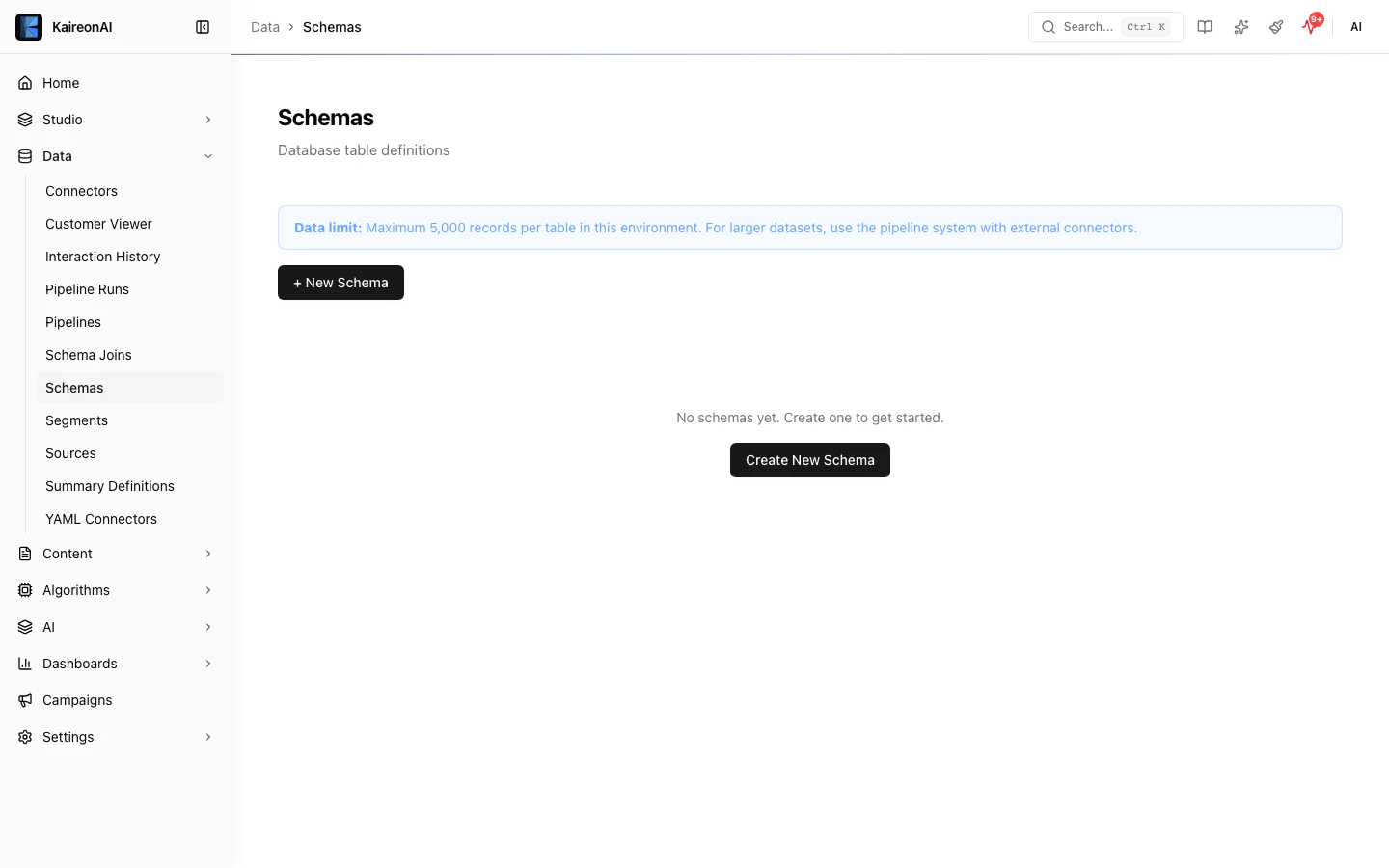
/api/v1/schema-joins is the CRUD surface for join definitions — declarative links between two registered schemas on a primary-key/foreign-key pair. The API accepts the same join spec the visual schema-joins builder produces in the UI. Joins drive customer-360 enrichment, segment overlap calculations, and reach-estimate queries that span more than one schema.
What it does
Each join definition records the primary and foreign schema, the key field on each side, the join type, the auto-enrich flag, and an active/inactive status. Before persisting a join, the platform validates that both schemas exist for the tenant and that the named key fields exist on each schema. Invalid combinations are rejected with a400 and a precise error message rather than allowed to fail at query time.
The route handles four operations:
- List — return every join for the tenant, each enriched with the display names of the two schemas it links.
- Create — accept a new join after schema and field validation.
- Update — change fields on an existing join, re-validating any key combinations that changed.
- Delete — hard-delete a join.
Quick start
Create a join fromcustomers to accounts so customer reads automatically pull account fields:
How it works
Authentication and roles
Listing joins requires theviewer, editor, or admin role. Create, update, and delete each require editor or admin. Every handler binds the request to a tenant and scopes all database operations by tenant id — no cross-tenant joins are possible.
Field validation
On create, the platform validates each side once: it confirms the schema exists for the tenant, then confirms the named field exists on that schema. The error messages are precise:Schema {id} not found— when the schema id does not exist for the tenant.Field "{name}" not found in schema "{schemaName}"— when the schema exists but the named key column is missing.
List enrichment
The list response attachesprimarySchemaName and foreignSchemaName to each row, using the schema’s display name first, falling back to its internal name, then to "Unknown". This avoids a second round trip per row from the UI.
Reference
GET /api/v1/schema-joins
List all schema joins for the tenant, ordered by createdAt descending.
Response
Status codes
| Code | When |
|---|---|
| 200 | Returns the array (possibly empty) |
| 401 / 403 | Caller fails authentication or role check |
| 500 | Unexpected DB error |
POST /api/v1/schema-joins
Create a new join after schema/field validation.
Request body
The platform validates the body and rejects invalid join specs with400.
Display name. Must be at least 1 character.
Id of the primary schema. Must belong to the tenant.
Field name on the primary schema. Must exist as a registered field on the primary schema.
Id of the foreign schema. Must belong to the tenant.
Field name on the foreign schema. Must exist as a registered field on the foreign schema.
"left" (default) or "inner".When
true, customer-360 reads and enrichment stages auto-pull this join. When false, the join exists in the catalog but is opt-in per query.Response
201 Created with the created join row.
Status codes
| Code | When |
|---|---|
| 201 | Created |
| 400 | Invalid JSON body |
| 400 | Schema/field validation failure (with precise message) |
| 401 / 403 | Caller fails authentication or role check |
| 500 | Unexpected DB error |
PUT /api/v1/schema-joins
Update fields on an existing join. Re-runs validation for any side whose schema or key changed.
Request body
The platform validates the body and rejects invalid updates with400.
Id of the join to update.
New display name.
New primary schema id. When set, key validation re-runs against
primaryKey.New primary key field name.
New foreign schema id. When set, key validation re-runs against
foreignKey.New foreign key field name.
"left" or "inner".Toggle the auto-enrichment flag.
"active" or "inactive". inactive joins stay in the catalog but are skipped by enrichment paths.Response
200 OK with the updated join row.
Status codes
| Code | When |
|---|---|
| 200 | Updated |
| 400 | Invalid JSON body or validation failure |
| 401 / 403 | Caller fails authentication or role check |
| 404 | Join not found for tenant |
| 500 | Unexpected DB error |
DELETE /api/v1/schema-joins?id={joinId}
Hard-delete a join. The id is read from the query string, not the path.
Query parameters
Id of the join to delete.
Response
Status codes
| Code | When |
|---|---|
| 200 | Deleted |
| 400 | Missing id query parameter |
| 401 / 403 | Caller fails authentication or role check |
| 404 | Join not found for tenant |
| 500 | Unexpected DB error |
Required headers
| Header | Required | Purpose |
|---|---|---|
Content-Type | POST / PUT only | application/json |
X-API-Key | Yes (one of the two) | API key (krn_…) |
X-Tenant-Id | Yes (one of the two) | Direct tenant id |
Honest limits
- The route does not enforce a uniqueness constraint on
{ primarySchemaId, primaryKey, foreignSchemaId, foreignKey }. Operators can register multiple joins with the same key pair (e.g., oneactiveand oneinactive) — the consumer-side enrichment code picks the firstactiverow it finds. joinTypeis restricted to"left"and"inner". Right and outer joins are not supported in V1 — enforce them by inverting the primary/foreign relationship instead.- Deletes are unconditional — no foreign-key guard prevents removing a join that an active enrichment stage relies on. Callers should set
status: "inactive"for a phased deprecation rather than deleting in production. - The delete endpoint reads
idfrom the query string, not a path param, to allow batch tools to pass the id outside the URL path.
Related
- Schemas — register the schemas referenced by
primarySchemaIdandforeignSchemaId. - Customers — Unified Profile — consumes auto-enrich joins for customer-360 reads.
- Segment Overlap — reads cross-schema joins to compute audience intersections.
- Reach Estimate — uses joins for cross-schema rule reach calculations.